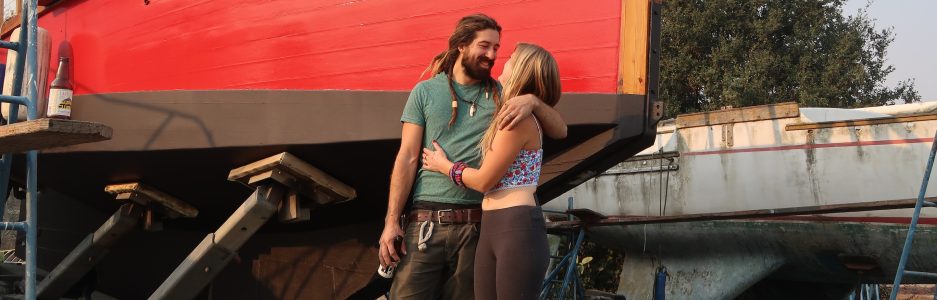
In Washington, where we built most of the boat, we cut down some trees for masts. This was about 3 years ago. With still having so much to think and do to build the boat our masts were neglected. We jumped a little ahead of ourselves and didn’t give the spars the attention they deserved. Rediviva is a gaff ketch which means she’ll have two masts, a taller one up forward (the main) and a shorter spar (the mizzen) aft. Now our main is still in good shape but the mizzen has a kink at one end. The trees being green needed to be turned every so often to remain straight and dry evenly, this didn’t happen as often as the mizzen needed. Our mizzen will not be scrapped we can still cut it up and use it for our main boom and gaff. Repurposed.
The main will now be the mizzen and we will build a better stick for our main. The new main will be laminated which will be stronger and we can control the taper. The main will not have any taper until you reach the hounds. The hounds are what the stays rap around. The stays are the wire rigging that hold the mast up. The four feet at the top of the mast will taper down a bit and then be painted white, as is tradition. The rest of the spar will be souped. Now to do this project we’ve gone back to the Napa Valley Marina and asked if they might rent us a space. The boatyard has been so amazing to us and found a little corner of the yard 40 feet long, exactly what we need, and about 5 feet wide for us to work.

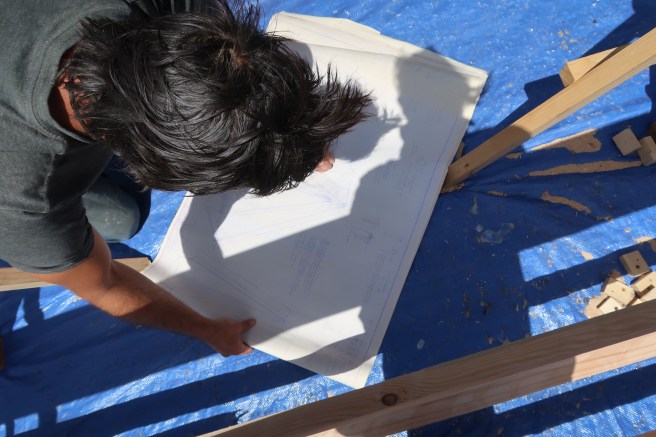
That day we got started. First Garrett had to build 7 level stands for us to work from. The mast needs to be straight!
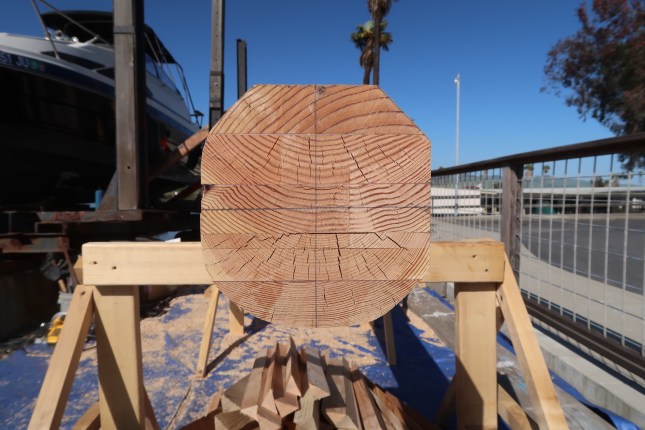
The lamination is five layers. 3 layers are two 20 footers and the other 2 layers consist of a 16 footer and two 12 footers. We did a test clamp up to make sure we had enough.

It took every clamp we owned and we made some 2by clamps as well. The 2by clamps are to keep the sides of the mast together and the million other clamps are to clamp it down tight.

To make sure the mast is straight Garrett also ran a string taut and then fastened little blocks to each stand. We put the first layer down and added another set of blocks to the other side. This seemed like such a huge project but once you get to doing it it’s just a matter of taking the steps and getting it done. Our keel timber was done is this very same way. It wasn’t as long but it was much wider and many more layers. This time we had, Garrett’s brother, Reid’s help to glue.

3 sets of hands is better than 2. We laid wax paper under the mast and over the blocks. It’s amazing for how sticky epoxy is it doesn’t adhere to wax or parchment paper.

Garrett and Reid spread out the epoxy while I made batch after batch of slightly thickened epoxy. It must’ve been 2 hours and the epoxy was spread on both sides of every layer and stacked. Then we worked quickly to get ALL the clamps on. Garrett’s hands wrenched them all tight, Reid laid down the wax paper, and I went around the mast scrapping the excess. Sorry there aren’t more photos of the lay up…sticky hands, but the camera was rolling.
This was a long day that deserved the reward of a taco night! We made all 12 of the 2by clamps that morning, glued, clamped, and cleaned. There was awesome spill out of every seem meaning we have a solid lamination.
The next morning we drove out to see how she was settling. The first 2 layers were hard but the other 3 were still a little tacky. Good excuse to take the beautiful day off. We didn’t do anything interesting. Mostly sat outside in the shade with a glass of wine then made dinner. Garrett still couldn’t help himself from opening the computer and doing more research. On what? Who knows. “Everything,” he said to me.

The epoxy was frozen in time. Tough as nails. It feels really nice working in the boatyard. You just have to make sure you don’t stay too long. That’s the problem with yards. People get stuck. It can feel like a place where boats go to die but in this yard there are all types of projects. Weekend haul outers, mast builders, simple bottom jobs, some serious rebuilds, and the projects that never leave too. The hum of the yard is encouraging. Everyone slowly chipping and grinding away. We’re happy to be refreshing our relationship with the yard because come July (or so) we will be hauling Rediviva. As the summer heat is approaching we want to try and keep the haul out to a week or two just to add a few more layers of bottom paint and, drum roll please, step the masts!
Removing the clamps revealed one straight square mast. Now to shape. The main will be round and to get it there Garrett must first 8 side the mast (with the skill saw) and then plane those edges and then stepping down from Festool, to orbital, to finish sander. Glueing was the easy part 😉
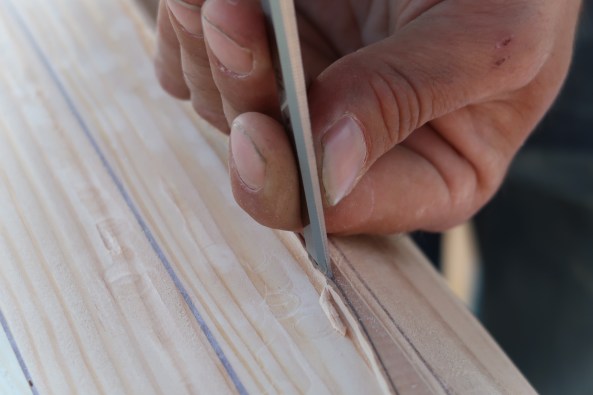
The electric hand plane was up to bat first. Cleaning all four sides smooth. It wasn’t too bad as I scrapped as much as I could but behind the wax paper and clamps the epoxy was thick.

The glue between layers looked great. Garrett was very satisfied. This day also included cutting off the over hang of both the top and bottom to get the mast to 39 feet. The top end is flush but the bottom has the male (peg) partner for the mast step. Both masts are keel stepped. This means the masts go through the deck and sits atop a wood block (the mast step) with a female square carved out to receive the mast. It will be a snug fit and where the mast passes through the deck there will be locust wedges to snug it and then a canvas boot to keep the water out.

All this work
and
NO HELP
from Swab
… he was busy though… eating sticks.

We started last Wednesday and a week into the project today Garrett is almost done ruff rounding the mast. This post is just the first 3 days! To keep our yard fees down we hope to finish and move that mast to storage here until we’re ready to bring Rediviva back down river. The goal is to have the mast finished in two weeks. One more week to go and we are looking good. It’s nice to know that when we’re motivated the work goes quick. We’ll have to finish installing the motor and get the bowsprit and windlass situated and if we still have time maybe plank the deck!
Whoo! All this work in the spring and summer will hopefully pay off in the fall when we can hoist some sails!!!

About a week or two ago we finished planking the port side bulwarks. I’m a little late posting this update because we’ve started our next big project (working on the masts) but more on that later.

First we moved Rediviva over to the other side of the dock then went and picked out our first run’s planks from the truck. Our lovely Toyota has been a champ over the last 4 years. Working just as hard as we have. It’s been our mobile lumber yard, tool storage, and all the normal things you need a vehicle for.
Rediviva is homemade and that being said is not perfectly symmetrical. We wanted to try and match the starboard side using the same lengths but it didn’t quite work out that way. In order to have the butts of the planks land on a stanchion we sometimes had to go the next length up to make that happen. We weren’t way off it just wasn’t quite equal…

We moved a bit faster on day one of planking having done it already and got one more run of planking up than last time. Needless to say we were pretty pooped when the day was done. The sun has been so wonderful to work under and with some pink skin we loved the moment our heads hit the pillow!
When day broke we put our hats on and got back at it.
We had our system down and it was just another day at the office. Fitting planks and drilling holes.
Since Rediviva over hangs the dock by a bit most of the drilling happened from the dinghy. With a little water floating in the bilge our feet were happy to soak in the cool liquid. This is also when we got to row back a little to admire the finish of every run. Being huge boat nerds this never got old.
Just like the starboard side it took two days to plank then another two days to sand and even face the bulwarks.
Then the finishing touch of souping the bulwarks.
We still have to lop off the tops of the stanchions and add the cap rail, trim and round the ends of the planks at the bow, and plank the transom. A few more decisions have to be made to do two out of those three things. How do we want the tiller to come through, over, or under the bulwarks? And do we want the cap rail to follow the angle of the deck or have it flat??
We can however round the tips of the planking at the bow. There’s a space here left open so we can fit in our 8 by 8 bowsprit which will hang out past the stem 10 feet. Garrett wanted 12… We’ve decided to make the bowsprit hinging so when we need a slip in a marina we can save 10 feet of slip fees, which add up quick. We will also have a sampson post that goes through the deck down to the forefoot behind the bowsprit. We’ve ordered a beam from a local lumber yard for the sprit and sampson post it just hasn’t come in yet. When we get those two things installed we can then mount our windlass!
So while we wait for the beam and are anxious to start the next project we head out to the boatyard. Our friends at the Napa Valley Boatyard have kindly rented us a space to tackle the next big task: rebuilding the main mast. It’s a bit of a long story which I’ll fill you in on soon but we’ve decided to laminate our main mast and our epoxy has just arrived in the mail!

Our current goal is to haul out in July and freshen up our bottom paint and step the masts. Assuming we’ve finished installing the motor by then when we leave the boatyard this time it’ll be to head out to the bay. Making Sausalito our home base and continuing to work on anchor. This might seem like it’d be more difficult but Garrett and I have a tendency to do things the hard way. Like build a boat. We need the encouragement of life on the hook to keep a steady pace and get Rediviva sailing this fall. Our biggest project on anchor will be making the sails. We have a few head sails that have been donated but stitching up our main and mizzen gaff sails will be something new and different for us to learn. Forever challenging ourselves I guess 🙂
Cheers!
~Ruthie
p.s. Photos and the full story of the main mast coming in a day or two! Thanks everyone
Amazon
a HUGE thank you to everyone that has purchased items off our wishlist. You are giving us a big step forward in the projects to come. We’ve never had such nice tools. You all are amazing, beautiful, wonderful people that we adore!
(Not every package has come with a gift note so if you haven’t received a thank you our apologies and please feel free to message us so we can properly thank you)
There comes a day when all the prep work is done and you finally get to put up planks. The big moment where all your planning, hunting, and gathering pays off in visual progress.

We went into planking the bulwarks thinking we were going to do six runs of planking. Each run consisting of two to three planks. Our first one, being the important trend setter for the rest of the runs, had to be out of two pieces so we only have one butt to mess with. Attempting to make that butt joint seamless. We thought we’d have to use two 20 footers but to our delight a 20 and a 16 did it.

We wanted a little room between the bulwark planking and the deck for water drainage so we used some off cuts of port orford cedar to gauge that space at the base of every stanchion.

Once pleased with how everything looked Garrett drove the fasteners home. On every stanchion each plank was fastened in two places with an 8 gauge stainless steel inch and 5/8th’s screw. The planks bent easy and were held temporarily in place with at least two clamps. Back to that tingling soreness in Garrett’s hands where even after the sun has set the pulse of the day continues to beat.

Much like the hull planking and the sheathing, when you put up a plank, no matter how long or tall, you have to stand back and admire how the boat is transforming. It’s much nicer this time that this can be done from the dinghy! In the WATER.

Day one of putting planks to stanchions finished with run two. The day was glorious. We definitely took our time to appreciate every board and the fact we were finally completing the bulwarks the way Garrett wanted. If you can remember far enough back we’ve already done the bulwarks once before but they turned out to be more decorative than anything. Short little stubby things not tied into the structure of the boat. The original dream for building Rediviva was to keep her as traditional as possible. This includes “ship bulwarks,” ones that make you feel safe and secure on deck. When a ruff sea hits you certainly won’t feel fear going forward to change sails!
We staggered the butts at least a stanchion away from each other. The starboard side’s first four runs we were able to alternate 20 than a 16, then a 16 then a 20, and so on. Like every human we are not perfectly symmetrical neither is Rediviva. The port side took a couple different lengths to stagger the butts and keep longer length planks in use for they were the easiest to bend into shape.

Day two started out with cloudy weather perfect for coffee and as the day progressed those clouds parted and the sun signaled it was time for a beer while we gazed upon completing run number three.

Run number three was cutting it close trying to use a 20 footer and still make a solid landing on the first stanchion as well as the stanchion at midship where it ended.

Finishing that run was easier than starting it. Moving on! Run four, like the rest, started with Garrett inspecting which plank is best; curve, grain, and dryness. We are using green lumber and thanks to a follower that bought the moisture meter from the Amazon wishlist we were able to test each board and see how it’s drying. After cutting our raw boards down to the 1in x 3in plank they were beginning to dry nicely. We started with a meter reading in the teens to low twenties of percentage of moisture and by the time we were ready to plank some boards were as low as 10%.

After run four this was when we questioned whether or not 6 runs is too many. Four was looking pretty tall… Making the final decision after we completed the fifth run; in deed six was too many and five was enough.
Our long clamps have taken a beating from the original planking. We may have pushed them to their limits twisting and bending old growth vertical grain 2in by 3 or 5in wide douglas fir topside planks into place. We dug them back out to serve once again finishing the starboard side bulwark planking which towered above MY head.

Being in the full swing of things day two finished the starboard side. Completing the starboard side in two days felt incredible. Full days of work with the beautiful sun shining above us. So two days of putting planks up then another two full days sanding, leveling, and bunging that whole side.
Once we got to souping the bulwarks we were excited to be back to putting planks up on the port side. Sanding wasn’t nearly as fun as planking under the burning ball of fire in the sky. We needed the weekend to recover and regain strength!

Perfect timing for the sky to leak. We needed a day to relax but still feeling guilty about not working on the boat the universe helped us out and gave us a rainy day. Sure makes it easier to just chill on a blustery day than if it was beautiful working weather. After we get the port side even to starboard we’ll figure out the cap rail and transom bulwark planks. The stanchions are left long for now until we decide whether the cap rail will be level or follow the crown of the deck like the bulwarks do leaning slightly outboard.
We are so pleased with these bulwarks. The height is perfect and the foredeck space for working the main mast with the added security of the bulwarks is insane. So happy! The bulwarks are awesome!!!

Rediviva is about to look really different. We’ve been ripping lumber for days for her bulwark planking and finished last week.
We had our new safety goggles and Swab had his new squeaky squirrel. We did another run to Home Depot to see if we could find any more long pieces knowing they’d be easier to bend around the stanchions and take the shape of the boat. We certainly scored and ended up with more material than we needed. “Needed,” Garrett corrects me that we do NEED them…for other things
Before we could start planking we had to install four more stanchions. Two in the bow and two in the stern. The bow additions will be on either side of the bowsprit and are a little closer in distance to the other stanchions and at a slightly different angle. The stern stanchions are further apart and the transom planks will also tie into these posts. We’re still deciding exactly how we want to plank the transom so there will be eventually two more posts in the stern later. Their placement depends on how we want the tiller to come through; under, over, or through.
It’s always weird cutting holes in the boat but we’ve gotten pretty used to it by now. Garrett loves it because it means more parts are being added that make her a real sailboat.
The day was absolutely gorgeous! Even Swab, who usually likes to stay up by the house, was happy on deck. He typically needs encouragement to come down to the boat, I don’t think he likes the crown in the deck which soon won’t give you vertigo anymore with the bulwarks planked, but he galloped down the gangway still sporting his bandana from milling our planking stock (he had to match us 😉
Same routine as when we did the other stanchions; Garrett down below fastening and me on deck aligning.
I realized I never gave you a good photo of the stanchions after sanding and re-souping so here they are! I spruced up our companion way hatch too:

We just can’t wait until the whole deck looks like this! It feels amazing to be working on deck. So nice to get out of the boat. We just have to be careful that we don’t get carried away and forget to finish hooking up the engine. What’s all this beautiful wood just sitting at the dock for ??? got to get the boat mobile!
To finish installing the additional stanchions Garrett dug out his irons and mallet once again. With a more extreme angle on these guys he had to use a few different irons to hammer in the cotton properly. Like a painter and his brushes.
Our little ship is about to get some serious bulwarks. The plan is to also have lifelines atop the cap rail of the bulwarks to really make you feel secure on deck. Working her gaff sails and making fast her lines to the pin rail while bracing your feet against the sturdy bulwarks is a dream.
I taped and Garrett applied the sikaflex compound making Rediviva watertight once again. After a day waiting for it to dry we were ready to begin planking.

With our arsenal of stainless steel screws and a bunch of clamps we picked our first pieces for run number one.

The first run is the most important as it sets the line for every other plank thereafter. The planks bent easy and in two days we had the starboard side completely planked but more on that next post 😉

Charlie has helped with our parrel beads and now the dead eyes. Next project will be belaying pins. He has an awesome wood lathe perfect for the job.

The dead eyes are for the standing rigging. We will have 10 sets for our rig; 3 for the main and 2 for the mizzen. Dead eyes are traditional and today most boats use turnbuckles to tension their rig.

The top eye will have a rounded groove around the outside to receive the wire stay and the lower eye will have a 90 degree flat groove for the bracket that attaches it to the chainplates. A line is looped through the holes, called a lanyard, and knotted at the start then tensioned at the other end either fastened up to the stay or back on itself once the rig is tightened. To the right is just a demonstration. Our dead eyes will be about 3 3/4” round with 1/2” holes. Three strand line is what we’ll use for the line to stay traditional. Most likely our stays are looking like we’ll make out of 3/8in galvy wire.
First step was getting ruff blocks out of our 2×6 stock of black locust then using the template Charlie made in accordance with the grain pattern we want we marked the top and hammered a pin in the three places we wanted the holes.
Charlie also made a template for his lathe to cut the dead eyes round. Securing two bolts, locked the dead eye to the lathe and after a few passes we got down to the width we wanted.
Charlie taught me how to mark the ruff blocks so he could start drilling the holes while Garrett finished cutting the blocks.
We danced around Charlie’s shop in unison. Garrett took over drilling holes and Charlie switched to the bandsaw to get our ruff circular shape before moving onto the lathe.
Are you starting to see it?
Then to the coolest machine. The lathe. Rounding the dead eyes took a couple passes.
It was a great day! Charlie is a monster of efficiency. Garrett continued cutting the ruff shape with the bandsaw then passing them onto Charlie.
It wasn’t before long that we had a whole tray of deadeyes. We didn’t totally finish the job this day but we got pretty far!
The final step we got to that day was as Charlie finished rounding on the lathe he passed them back to Garrett to take them to the router to smooth the edges.
Here’s the before edge rounding and after:

Next time we’ll cut the grooves on the top and bottom eyes and also add the soft groove where the lanyard passes through the holes of the dead eye. Garrett wanted to do a little more research for the appropriate size bracket for our bottom eye where it’d attach to the chainplate before we cut the groove. It was really nice doing a project for the boat but away from the boat. We’ve still been having off and on rainy days so this helped keep the sanity cup full 😉

All 10 sets are rounded into shape with 5 extra eyes to spare in case we break any down the line. One step closer to raising the masts therefore closer to sailing!!!!
Thank you Charlie!
We’ve been waiting for this day. We were rained out the previous day and eager to get to some real work on the next project; the bulwark planking. Every Home Depot run was also a scouting mission to find pieces of lumber for the task. Four maybe five trips, spread out over weeks, we found all we needed in the construction grade lumber pile. It may be green but nearly all pieces are clear and will dry quick with the change in weather. A little help will come from the wood being a bit green anyway; making them easier to bend and take the curve of the dramatic sheer Rediviva has.
When we got to my parent’s house there was a lovely package waiting on the porch. A brand new circular saw to replace the very tired one we have. Our old saw is patched in two places on the cord, doesn’t allow you to adjust depth anymore, and the base no longer stays level… It was time. Thanks to Sean!!! Garrett is looking more professional everyday. He’s got the haircut now he just needs the tools. Sean is also the main drive behind starting the Amazon Wishlist which has blown our minds! It has been far more successful than we ever imagined. With giant smiles on our faces and gratitude in our hearts we are going to kick some boatbuilding butt!

From the last two t-shirt sales on Bonfire we bought ourselves a brand new 10” table saw. We’ve been working off the same saw since Washington and we’re convinced it’s cursed. Probably from its previous owner’s wife who hated him spending more time in the yard than with her. It was supposed to be top brand, JET, but it never could keep up with us. Those days are now in the past!
Our pile was high and the goal is to get 3”x1” planks to cover the bulwarks. To best describe bulwarks I say it’s a lot like our “fence” around our home but on a boat. To reach the goal we have three cuts to make. #1 Get a clean edge. Looking at each board individually then deciding the best edge to remove taking into consideration any knots or odd bends, curves, or wonky bits in the board and how best to get as many 3” planks per board. Any thicker off-cuts will be used for deck planking if possible. #2 Rip each board into the number of 3” planks we can get. We had 2×4’s, 2×6’s, 2×8’s, 2×10’s, and 2×12’s so all but the 4bys and 6bys we could get multiple planks. #3 Rip every plank on edge to bring them to an inch of thickness. We didn’t get this far…
Towards the end of the day the new tablesaw’s fence began to slip. We went to rip a board set at the same width it had been and nothing was removed… Got the measuring tape and ah-ha we are not ripping at precisely 3” any more… So… how many do we now have to re-rip??? Turns out just 6 planks were off but the fence continued to slip so we had to check each board before and after and the distance on the saw. Needless to say this sucked the rest of the daylight time we had.
We cut 41 planks. We need 36. This leaves a couple extra if any break while trying to take the bend. We have a whole mix of lengths. Starting at the bow, where the bend is more extreme, we want the longest pieces. In total, each side (port and starboard,) will have 6 runs consisting of 2-4 planks. On the right side of the notebook (above) is a ruff plan of how we’ll lay out the runs. Run one is closest to the deck then we’ll work our way up. This is also the most important because it sets the line for the rest of the runs. There will be a little gap between the deck and the start of the bulwark planks for water shedding. For this beginning run we’ll do it out of two 20 foot pieces. The longer the board the easier it is to bend them into place and because two 20’s will do the length of the boat this also means only one butt joint (where the two pieces meet up on a stantion) which is good for the eyes, one straight line.
Before After
Garrett and I are so anxious to get outside! The engine is still coming together and that’s what we work on when it’s raining but our real motivation is in the next projects that get us outside. “We are solar powered,” Garrett says and it’s so true. The energy we get from sunny days and fresh air is paramount. It was nice too to be doing a boat project separate from the boat. Garrett’s been cooped up inside for far too long. The slight tinge of sunburn on our shoulders is invigorating.

To top off and make this great day even better we had some more presents on the stoop.
Thank YOU:
Joanna
Frans
Dennis
Yup…
Garrett was stoked!